PREPARE TO PERFORM IN YOUR MEDICAL SCHOOL INTERVIEW
The questions medical schools actually ask, marked the way admissions tutors mark them — so you walk in knowing you’re ready.
This interview may be your only chance to get into medical school
No resits. No second attempt. Your performance determines the outcome.
Medical school interviews are structured assessments. You are judged not just on what you say, but how you think, how you respond under pressure, and how clearly you structure your answers.

Real questions.
Real marking.
THE ADVANTAGE
TRAIN IN A REAL-TIME INTERVIEW ENVIRONMENT
Our AI interviewer:
 Opens on the question and waits while you think — no welcome speech, no filler, no talking over you
- Asks each question exactly as written, the way a real MMI station does, so every candidate gets the same interview
- Stays neutral between questions — a real examiner reads the next card and waits
- Marks your answer against the station's framework as you finish it
What you experience:
- 200 real medical school interview questions across 9 station types
- 5-minute spoken stations, and a 6-station video mock in 15 minutes
- Continuous interaction — no pauses, no rewrites, no second take
- Thinking and responding under real interview time pressure
STRUCTURE
BUILT AROUND HOW CANDIDATES ARE ACTUALLY ASSESSED
Practise one station at a time out loud, or run a 6-station video mock that moves you on at the bell, the way a real circuit does. Every station draws from the same 200 published questions.
Each station has its own framework, its own mark, and its own line on your readiness score — so you can see exactly which of the nine you still need to work on.
Your interview progresses through core admissions categories:

HOW IT WORKS
A STRUCTURED, REAL-TIME INTERVIEW PROCESS
Pick a station — or run the full video mock — and start talking.
Answer real questions out loud. Each one is marked against its framework as you finish it.
Get the debrief, watch your readiness score move, and practise what it points at next.
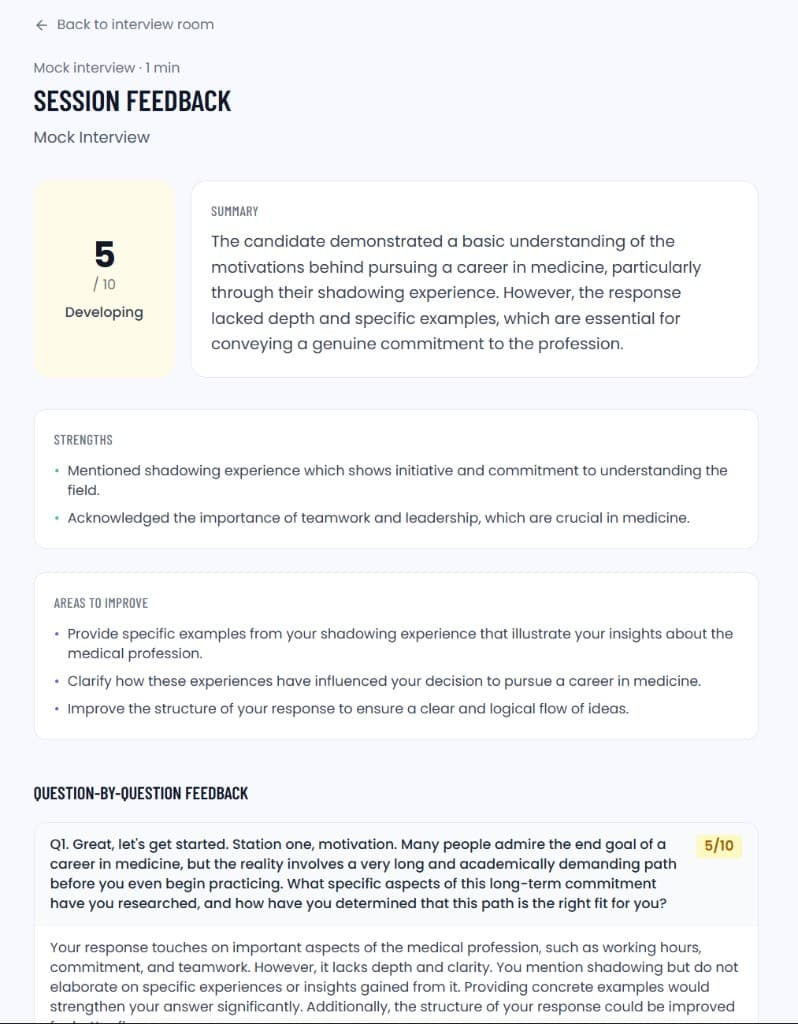
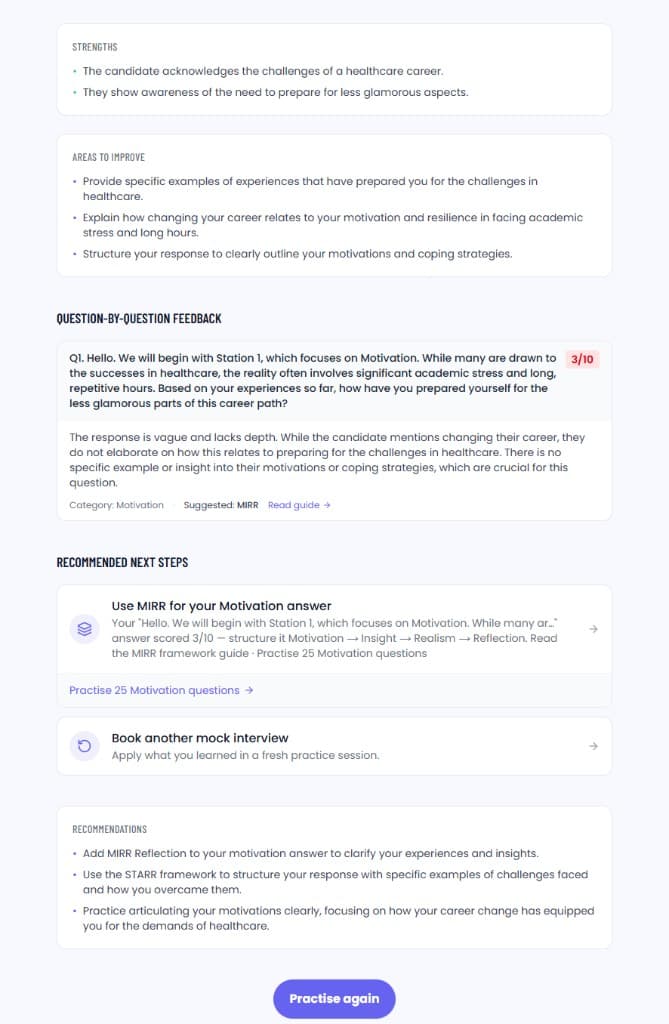
SESSION FEEDBACK
FEEDBACK THAT TELLS YOU EXACTLY WHAT TO DO NEXT
When a station ends, you don't get a vague score. You get a structured debrief aligned to how medical schools actually assess candidates — with frameworks, guides and model answers built in, and a countdown to your interview date sitting above it.
Marked while you answer
A score out of 10, what worked and what would have lifted it — on screen as you finish each answer, not in an email a week later.
Question by question, kept
Every answer in the debrief carries its own mark and its own 'what would have made this stronger', saved to your account so you can come back to it.
Framework-led coaching
Specific suggestions like MIRR for motivation or STARR for behavioural answers, with the full guide and a model answer a click away.
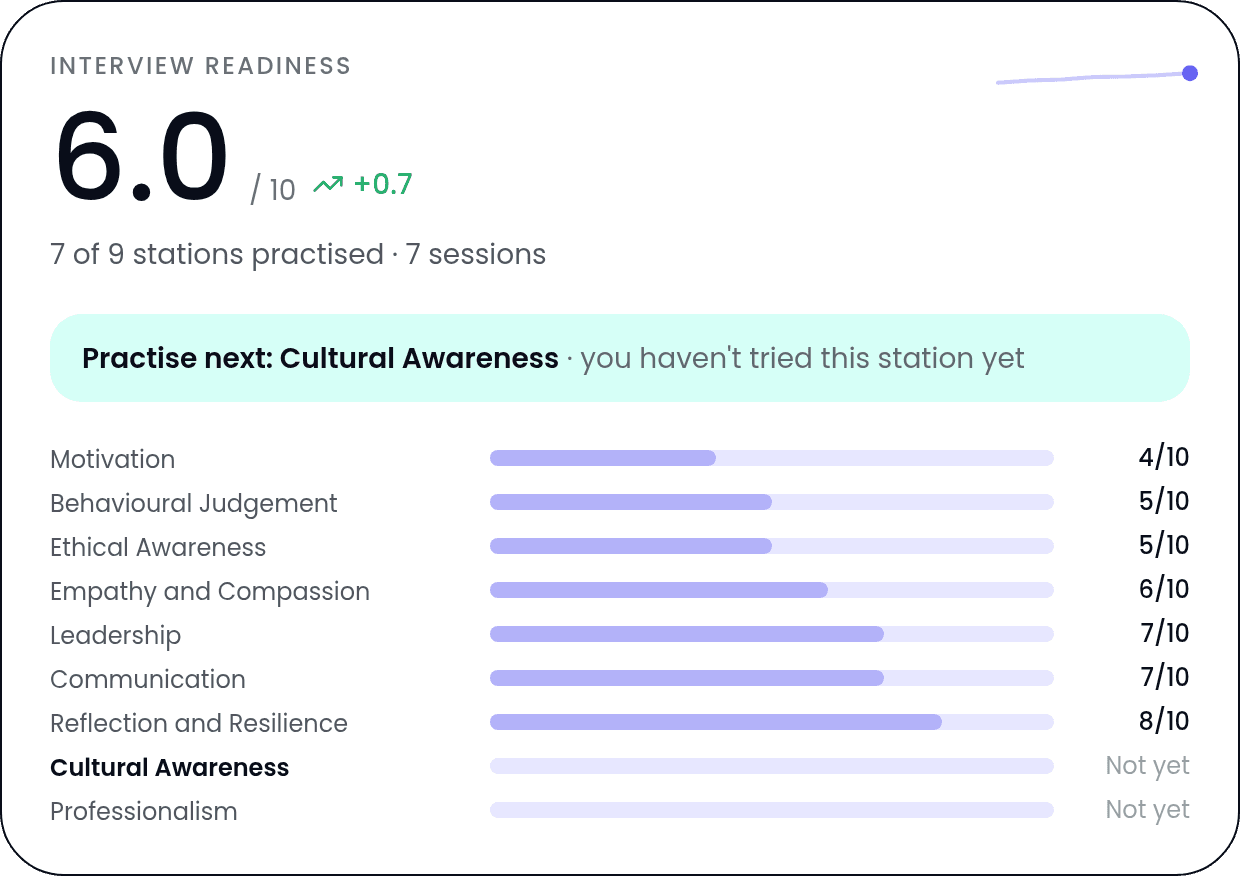
One readiness score
Your latest mark on every station, averaged into a single number with a trend line — and a 'practise next' that points at the station holding it down.
SMARTER NEXT STEPS
FROM FEEDBACK TO FOCUSED PRACTICE
Your weakest answers drive the recommendations. We suggest the right framework for each category, link you to the prep guide, and send you straight to targeted questions in the question bank.
Progress
KNOW WHERE YOU STAND BEFORE THE DAY
One number for how ready you are, built from your latest score on every station, so you stop guessing which weakness to work on.
An interview readiness score
Your latest score on each of the 9 stations, averaged into one number out of ten — with the trend across your sessions, so you can see it move.
Practise next, chosen for you
The dashboard points at the station you have not tried yet, and after that at your lowest score. One tap selects it.
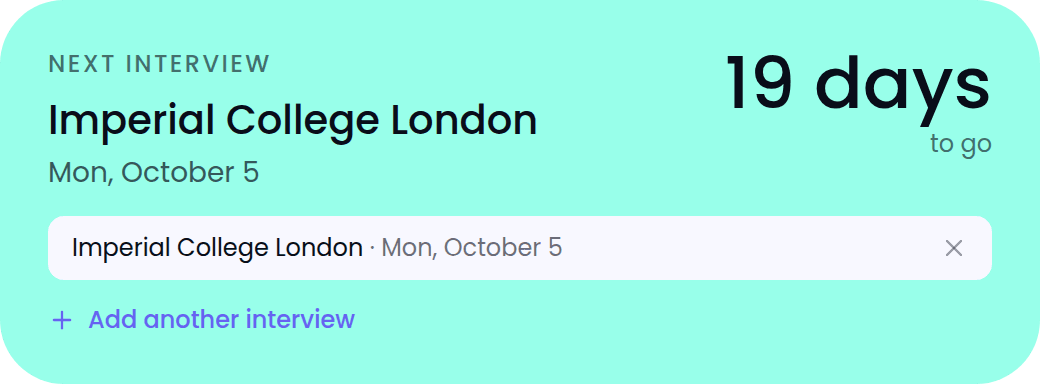
A countdown to your interview
Tell us the school and the date. The dashboard counts down to it and keeps every interview you have coming up in one place.
Every session kept
Your history, your scores and every debrief stay on your account — including the free one you started with.
Monthly interview prep plans
Each monthly plan includes spoken practice minutes and full 15-minute video mock interviews.
Entry
/ month
One interview a few weeks out. Enough spoken practice to cover every station twice, and one full video mock to rehearse the day.
- 120 min spoken practiceabout 24 marked stations
- 1 full video mock interview6 stations, 15 minutes each
Best for invite week
Drill
/ month
Invite week. Daily spoken practice, and two video mocks to get used to moving on at the bell.
- 250 min spoken practiceabout 50 marked stations
- 2 full video mock interviews6 stations, 15 minutes each
Intensive
/ month
Several interviews, or a lot riding on one. The most spoken time, and four video mocks to run a full circuit before each.
- 300 min spoken practiceabout 60 marked stations
- 4 full video mock interviews6 stations, 15 minutes each
EVERY PLAN INCLUDES
- All 200 real questions across 9 station types
- Live marking against named frameworks, with model answers
- Readiness score, practise-next and interview countdown
- Every debrief kept on your account
- 15 grace minutes — never cut off mid-answer
Not sure which? Start with the free one.
WHAT YOU THINK ABOUT GODOCTOR

INTERVIEW GUIDES
HOW TO ANSWER WHAT THEY ACTUALLY ASK
View all interview guides SPIES Framework: Raising Concerns About A Colleague
Use the SPIES framework — Seek information, Patient safety, Initiative, Escalate, Support — for difficult colleague and raising concerns scenarios in medical school MMI interviews.
 ETHICS Four Principles: Worked Examples Beyond One Scenario
Apply autonomy, beneficence, non-maleficence, and justice across confidentiality, consent, resource allocation, and vaccination — with worked ethics examples for medical school interviews.
 GIBBS Reflective Cycle For Tell Me About A Time You Failed
Use the GIBBS reflective cycle — Description, Feelings, Evaluation, Analysis, Conclusion, Action Plan — for failure, reflection, and resilience questions in medical school interviews.
 EMP Framework For Patient Communication Stations
Deep-dive on Explore, Mirror, Partner (EMP) for MMI patient communication — role play, rapport, and difficult conversations in medical school interviews.
 SPIKES: Breaking Bad News In MMI Role Play
A deep-dive on the SPIKES framework for MMI role play — setting, perception, invitation, knowledge, empathy, and strategy — with worked examples for medical school interviews.
 STARR Vs MIRR: Which Framework For Which Question
When to use STARR vs MIRR in medical school interviews — question types, examples, and links to Go Doctor's framework reference and question bank.
THE OUTCOME
ENTER YOUR INTERVIEW PREPARED TO COMPETE
By the time you sit your real interview, you will have:
- Answered real medical school interview questions out loud, under time, and been marked on every one
- Used the right framework for each station type, and seen where it slipped
- Watched a readiness score move as your weakest stations came up
- Run the full circuit — the bell, the transitions, the pressure — before it counted
You won't be wondering how you'll perform.
You will know.